Why Your Warm-Up Sets Feel Heavier Than Your Work Sets
Quick Answer: Warm-up sets often feel disproportionately heavy because your nervous system has not yet recruited its high-threshold motor units. It usually takes 2 to 3 progressively loaded sets before your body switches on the muscle fibers that do the real work. The fix is not to skip warm-ups, it is to warm up in the right order.
You put 45 pounds on the bar and it feels like a fight. Four sets later you are moving 95 for reps and it feels smoother than the empty bar did. You are not imagining it, and you are not warming up wrong in the way you think.

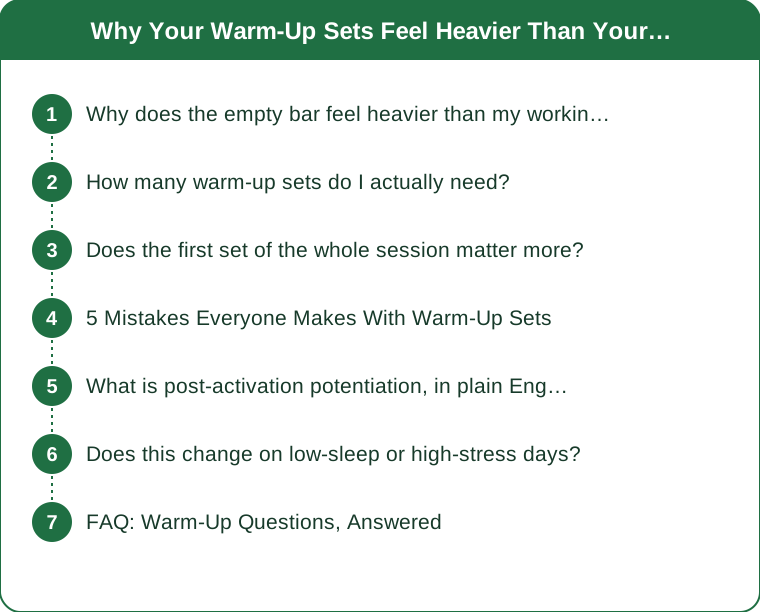
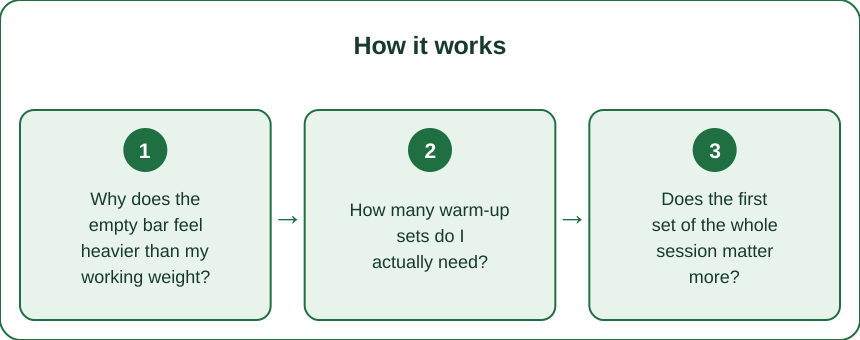
Why does the empty bar feel heavier than my working weight?
Your muscles do not fire all at once. They recruit motor units in order of size, smallest and weakest first, largest and strongest last. This is called the size principle, and it means the first set of the day is powered mostly by your least capable fibers.
Until the load gets high enough, or you have done enough reps, your body simply has no reason to call up the big units. So the light bar is being lifted by your B-team, and it feels exactly as hard as a B-team effort should.
By set four, the A-team is awake. Same body, different roster.
How many warm-up sets do I actually need?
For most lifters working in the 5 to 10 rep range, 3 to 4 warm-up sets gets the job done without draining you.
A reliable ladder to a 95 pound work set looks like this:
- Empty bar (45 lb) x 8 — slow, full range
- 55 lb x 5
- 75 lb x 3
- 85 lb x 1 or 2 — this is the one that flips the switch
- 95 lb x work sets
Rest 45 to 60 seconds between warm-ups, then 2 minutes before your first work set. Notice the reps go down as the weight goes up. Doing 8 reps at every warm-up weight is the most common way to arrive at your work set already tired.
Does the first set of the whole session matter more?
Yes, and this is where most people lose the session before it starts.
The first exercise of the day carries a double warm-up cost: you are warming up the movement pattern and the whole nervous system. Your second and third exercises inherit that work. This is why bench press feels awful when it is first and fine when it follows squats.
Give your first movement one extra warm-up set than you think you need. Every exercise after it needs fewer, often just one or two ramp-up sets, because the system is already online.

5 Mistakes Everyone Makes With Warm-Up Sets
1. Treating warm-ups as conditioning. Ten reps at 60 percent is a workout, not a warm-up. Keep total warm-up reps under about 20 across all sets.
2. Jumping straight to the work weight. Going from an empty bar to your top set skips the ramp entirely, and your first work set becomes a very expensive warm-up.
3. Resting too long between warm-ups. Three minutes of scrolling between light sets lets the effect fade. Keep it under a minute.
4. Static stretching first. Holding a stretch for 60 seconds before lifting temporarily reduces force output. Save the long holds for after.
5. Judging the day by set one. The third mistake surprises even experienced lifters, but this one derails more sessions: people feel a heavy warm-up, decide they are weak today, and drop their work weight before the nervous system has had a chance to show up.
What is post-activation potentiation, in plain English?
After a heavy or near-maximal effort, your muscles are temporarily more capable for several minutes. Coaches call this post-activation potentiation. You experience it as the strange lightness of a work set that follows a hard single.
You can use it on purpose. Before your top set, do one rep at roughly 5 to 10 pounds above your work weight, rest 2 minutes, then start your working sets. That single primes the system without accumulating fatigue.
This works best for compound lifts — squats, deadlifts, presses, rows. For isolation work like lateral raises, one light set is plenty.
Does this change on low-sleep or high-stress days?
It gets more pronounced. Poor sleep and high stress both blunt motor unit recruitment, which means the gap between how the warm-up feels and what you can actually lift gets wider, not narrower.
On those days, add one more warm-up step rather than cutting weight immediately. Ramp in smaller jumps, take slightly longer rests, and re-evaluate at your first work set instead of at the empty bar.
If the work set still moves badly after a proper ramp, that is real information. Then you drop 10 percent and call it a maintenance day. That is a good decision made with good data.
FAQ: Warm-Up Questions, Answered
Should I do cardio before lifting?
Five to eight minutes of easy movement raises tissue temperature and helps, but keep it genuinely easy. Twenty minutes on the stair climber before leg day is training, and it will cost you on the bar.
Do I need to warm up for every exercise?
Not fully. Your first movement of the day needs a complete ramp. After that, one or two ramp-up sets per new movement pattern is usually enough, especially if it uses similar muscles.
Is it normal for one side to feel heavier during warm-ups?
Mild asymmetry is common and often evens out by the work sets. If one side stays noticeably weaker across weeks, or if there is pain rather than effort, get it looked at by a professional. This is general information, not medical advice.
TL;DR:
- Warm-up sets feel heavy because your strongest muscle fibers have not been recruited yet — that is normal physiology, not a bad day
- Ramp in 3 to 4 sets with descending reps as weight climbs, resting under a minute between them
- Give your first exercise of the session one extra warm-up set; later exercises need far fewer
- A single near-work-weight rep two minutes before your top set makes the work set feel lighter
- Never judge your strength for the day until after a proper ramp
The next time the empty bar feels like a personal insult, finish the ramp before you decide anything. Most of the lifters who think they plateaued were actually just reading the first set as the whole story.
See It in Motion
Seen here: Yoga Jogger Sweatpants with Pockets — shop it on bubblelime.com
Keep Reading
This article is for general informational and styling purposes only. Fit, sizing, and product availability may vary.