Why Your Rest Between Sets Keeps Getting Longer Without You Noticing
Quick Answer: Untimed rest expands to roughly double what you intend. Between racking the weight, a phone check, a walk to the fountain and waiting for a machine, 90 planned seconds becomes three to four minutes. That is not automatically bad, but it quietly converts a metabolic session into a strength session, stretches a 45-minute workout to 75, and makes your set-to-set numbers look better than your actual capacity. Time it for two sessions and the problem solves itself.
You are not slacking. You racked the weight, answered one message, refilled the bottle, waited for someone to finish with the bench.
And the workout that used to take 45 minutes now reliably takes an hour and a quarter.

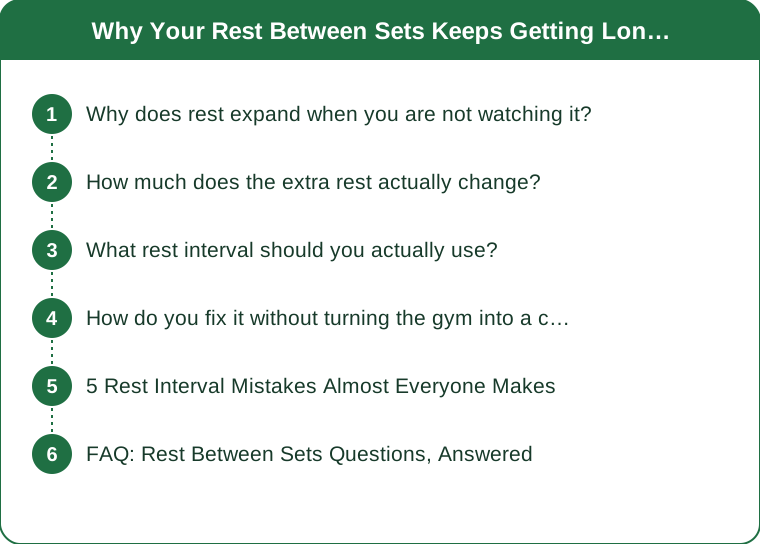
Why does rest expand when you are not watching it?
Rest without a timer is estimated by feel, and feel is calibrated to recovery, not to the clock. You move when you feel ready, and feeling ready arrives well after the physiological rest interval you planned.
Phone checks are the largest single contributor. A glance to change a song reliably becomes 60 to 90 seconds, and it does not register as rest because it does not feel like sitting still.
Shared equipment adds unplanned waiting that you never account for in the plan, and late August into September is exactly when the floor gets busier.
Setup time hides inside rest. Changing plates, adjusting a seat and finding the right dumbbells is two minutes that your plan counted as zero.
Conversation is the pleasant version of the same thing, and it is the hardest to cut because it is often the reason people keep showing up.
And nothing corrects it, because there is no signal that tells you the interval has run long. The set just starts whenever it starts.
How much does the extra rest actually change?
Longer rest means more complete phosphocreatine resynthesis, so the next set is genuinely stronger. Your logged numbers go up without your capacity changing.
Which means the log stops being comparable to itself if the rest interval is drifting from week to week.
Metabolic and conditioning effects fall off sharply past about two minutes, so if the session was meant to build work capacity, three-minute rests remove most of that.
Pure strength work benefits from three to five minutes, so the drift is not harmful there - it is only a problem if you did not choose it.
Total session time is the practical cost. Six extra sets at two minutes of drift is twelve minutes, and that is usually what makes a workout start feeling unsustainable.
And muscle stays warm for a limited window, so very long gaps mean the first few reps of each set are re-warming rather than working.
What rest interval should you actually use?
Heavy compound lifts at 1 to 5 reps: 3 to 5 minutes. Full recovery is the point, and rushing these costs you the load.
Hypertrophy work at 8 to 12 reps: 90 seconds to 2 minutes. This is the range that drifts most, and the one where drift changes the stimulus most.
Accessory and isolation work at 12 to 20 reps: 45 to 90 seconds. Short by design.
Supersets of non-competing muscles: rest after the pair, not between, which is the simplest way to compress a session without cutting volume.
Circuit and conditioning work: 30 to 60 seconds, and here the timer is not optional because the short interval is the entire training effect.
And on any given day, being slightly under-rested is a smaller error than being wildly over-rested, because it at least keeps the session in the shape you designed.

How do you fix it without turning the gym into a chore?
Start a countdown the moment the weight is racked, not when you sit down. Racking is the honest start of the interval.
Use the gym clock rather than your phone if picking up the phone is what starts the drift, which for most people it is.
Set up the next station during the rest instead of after it, so plate changes stop hiding inside the interval.
Put the phone in the bag for the working sets and accept the playlist you have. This one change usually recovers ten minutes a session.
Have a plan B lift for busy equipment, so waiting becomes substituting rather than standing.
And only time it strictly for two weeks. After that the pace is recalibrated and you can go back to feel with a much more accurate sense of what 90 seconds is.
5 Rest Interval Mistakes Almost Everyone Makes
1. Timing rest from when you sit down. The interval starts when the set ends. Counting from the moment you settle onto the bench routinely hides 30 to 40 seconds, which is a third of a hypertrophy rest period.
2. Using the same rest for every exercise in the session. A heavy squat and a lateral raise do not need the same recovery. Applying two minutes to both means the squat is under-rested and the raise is over-rested, and both lose something.
3. Comparing this week’s log to last week’s when the rest changed. If you rested 90 seconds in July and three minutes in August, the extra reps are a rest artefact, not progress. This is the quietest way to fool yourself about a plateau.
4. Cutting rest to save time on heavy days. Time savings should come from the accessory work, where short rest is appropriate anyway. Rushing the heavy compound is where the load actually drops.
5. Treating the timer as a rule rather than a floor. If the previous set genuinely wrecked you, another 30 seconds is a reasonable decision. The problem is not flexibility - it is unmeasured flexibility every single set.
And the one nobody admits: the busy-gym excuse. Waiting for a rack is real, but it accounts for a couple of sets a session, not all of them. The rest is the phone.
FAQ: Rest Between Sets Questions, Answered
Is longer rest bad for fat loss?
Not directly. Total training volume and overall energy balance matter far more than rest length. Longer rest mainly costs you session density and time.
Should I rest longer as I get stronger?
Often yes, for the heavy compound work. Bigger absolute loads take more out of you, and the recovery demand scales with them.
What if I feel ready before the timer?
On hypertrophy work, go. Feeling ready early is fine. The timer exists to stop the drift in the other direction.
Does walking around during rest help or hurt?
Light movement is fine and keeps you warm. The issue is that walking somewhere usually turns into doing something else for two minutes.
How do I rest properly in a crowded gym?
Pick exercises with equipment you can hold, superset with something bodyweight, and treat waiting time as part of the interval rather than in addition to it.
Is a rest timer app worth it?
Only if the phone is not the problem. For most people a plain gym wall clock works better because it does not open anything else.
TL;DR:
- Untimed rest reliably runs about double what you planned, mostly via phone checks and setup time.
- Longer rest makes your logged numbers look better without your capacity changing.
- Match the interval to the goal: 3 to 5 minutes heavy, 90 to 120 seconds for hypertrophy, 45 to 90 for accessories.
- Start the clock when the weight is racked, and set up the next station during the interval.
- Time it strictly for two weeks, then go back to feel with a recalibrated sense of the interval.
The session did not get longer because you got weaker. It got longer because nothing was counting.
See It in Motion
Seen here: Super High Waist Embossed Yoga Leggings with Inner Pocket — shop it on bubblelime.com
Keep Reading
This article is for general informational and styling purposes only. Fit, sizing, and product availability may vary.