Why Your Grip Gives Out Before the Muscle You're Training
Quick Answer: Grip fatigues faster than the large pulling muscles because the forearm flexors are small, work isometrically for the whole set, and recover slowly. When grip is the limiter, you are training grip and undertraining your back. Use straps on your heaviest pulling sets, train grip separately at the end of the session, and stop treating a failed grip as a reason to lower the weight.
You set the deadlift, everything feels strong, and by rep six the bar is rolling out of your fingers while your back is barely warm.
This is one of the most common ceilings women hit in the gym, and it has an unusually clean solution.

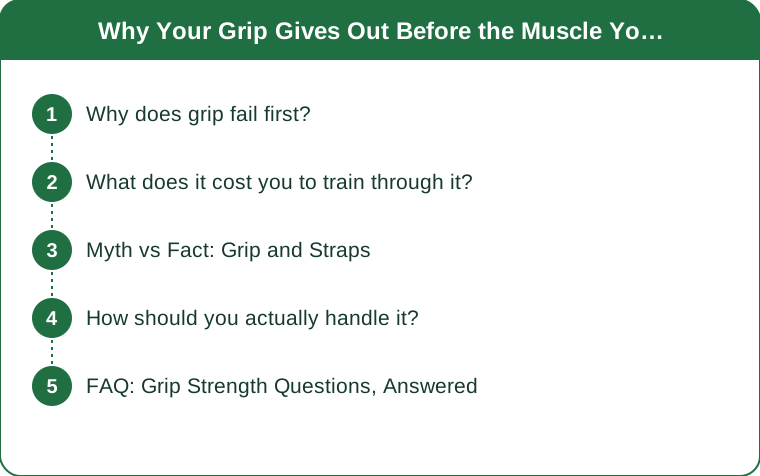
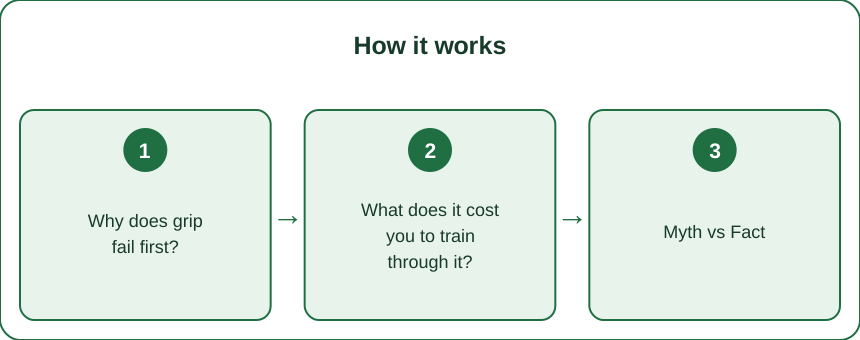
Why does grip fail first?
Structural reasons rather than a training failure.
The muscles are small and the leverage is bad. The forearm flexors that hold a bar are small muscles working through long tendons across multiple joints. The pulling muscles they are serving — lats, traps, rhomboids, spinal erectors — are among the largest in the body. A small muscle serving a large one will always be the constraint at some load.
Grip works isometrically for the entire set. Your back contracts and relaxes with each rep. Your hand holds continuously from the moment you grip the bar until you put it down. Sustained isometric contraction restricts blood flow to the working muscle, and metabolites accumulate quickly. That is why the failure feels sudden — it is not gradual fatigue, it is a threshold.
Hand size matters. Standard barbells are 28 to 32 mm in diameter, sized around an average male hand. Smaller hands wrap a proportionally smaller share of the bar’s circumference, which is a genuine mechanical disadvantage. This is why the problem is more pronounced for many women and is not a matter of effort.
Grip recovers slowly. Forearm endurance takes longer to return between sets than large-muscle strength does. By set four, grip has accumulated fatigue that your back has not.
What does it cost you to train through it?
More than most people account for.
- The target muscle is undertrained. If you stop a row at eight because your hands gave out, your back did the equivalent of a set of eight when it had twelve in it. Across months, that is a substantial volume deficit in the muscle you were trying to build.
- Load selection gets distorted. You end up choosing weights your grip can hold rather than weights your back should lift, so progressive overload stalls in the large muscles while the small ones stay maxed.
- Form degrades near grip failure. As the hands slip, people compensate — rounding to shorten the range, shrugging to reduce the moment arm, or jerking the weight. That is a worse rep and a higher risk one.
- Elbow and forearm irritation. Chronically maxing out grip on every pulling set is a plausible contributor to medial elbow discomfort, which is common and slow to resolve.
The useful reframe: grip should be trained deliberately, not accidentally. Letting it be the limiter on your main lifts trains it in the worst possible way — always to failure, always fatigued, never progressively — while sabotaging everything else.

Myth vs Fact: Grip and Straps
Myth: Using straps is cheating. Fact: Straps are a tool that lets you load the target muscle appropriately. Nobody thinks a squat rack is cheating. The relevant question is whether grip is the quality you are training in that set, and on a heavy row it is not.
Myth: Straps make your grip weak. Fact: They do so only if you never train grip at all. Using straps on heavy pulling and doing dedicated grip work afterwards produces better grip strength than grinding every set to hand failure, because the dedicated work can be progressive rather than always maximal.
Myth: Chalk is enough. Fact: Chalk addresses moisture and friction, and it genuinely helps — often more than people expect. It does not address the force capacity of the flexors, so it extends the set rather than removing the constraint.
Myth: A mixed grip solves it. Fact: It substantially increases the load you can hold, and it introduces an asymmetric load on the spine and a small but real biceps tear risk on the supinated side. Useful occasionally on a top set, poor as a default.
Myth: Grip strength is not worth training on its own. Fact: Grip strength is one of the more consistent correlates of general strength and has been associated with a range of health outcomes in large studies. It deserves its own place in the programme — just not as an unplanned tax on every set.
How should you actually handle it?
A simple order of operations:
1. Use straps on heavy pulling. Deadlifts above roughly 80 percent, heavy rows, heavy shrugs, long sets of pull-downs. The rule: if grip fails before the target muscle, strap up. No further justification is needed.
2. Keep some sets unstrapped. Warm-ups and lighter sets are free grip training and they add up over a week without costing anything.
3. Chalk everything. It is the cheapest improvement available and it addresses the moisture problem that makes hands slip well before they weaken.
4. Train grip deliberately at the end. Two or three short sets, twice a week, after your main work:
- Dead hangs — accumulate 60 to 90 seconds total, in as many sets as it takes
- Farmer’s carries — 30 to 40 metres, heavy, twice
- Plate pinches — for the thumb, which the other two do not train
5. Address the hand-size issue directly. Use a thinner-handled or women’s barbell where available — a 25 mm bar makes an immediate and often dramatic difference. For dumbbells, note that some brands have noticeably thicker handles than others, and choosing the thinner rack is legitimate.
6. Do not use straps for grip-training exercises. Obviously, but people do.
If you have wrist or elbow pain, numbness, or tingling in the fingers, that is a matter for a doctor rather than a grip programme. This is general information, not medical advice.
FAQ: Grip Strength Questions, Answered
How long until grip stops being the limiter?
With dedicated work two to three times a week, most people notice a meaningful difference in six to eight weeks. It may never fully stop being the limiter on maximal deadlifts, which is why competitive lifters use straps in training and a hook grip in competition.
Should I use straps on pull-ups?
Generally no — bodyweight pull-ups rarely reach a load where grip fails before the back, and the grip work is free. For weighted pull-ups with substantial added load, straps become reasonable.
Is a women’s bar actually different?
Yes: typically 25 mm diameter rather than 28 to 32 mm, shorter, and lighter at 15 kg. The diameter is the part that matters most for grip, and for many people it changes the experience of heavy pulling completely.
Why do my hands hurt more than they get tired?
That is usually skin and callus rather than muscle — pinching skin against a knurled bar. Chalk, a hook-style grip with the bar lower in the fingers, and maintaining calluses rather than letting them build up and tear all help. Gloves reduce pain but increase effective bar diameter, which can make the underlying strength problem worse.
TL;DR:
- Grip fails first because the forearm flexors are small, work isometrically all set, and recover slowly.
- When grip is the limiter, your back is undertrained and your load selection is being set by the wrong muscle.
- Use straps on heavy pulling, chalk everything, keep light sets unstrapped, and train grip deliberately at the end.
- A 25 mm women’s bar is a genuine mechanical fix, not a concession.
Strap up your heaviest row this week and see how many reps your back actually had. It is usually three or four more than you thought.
See It in Motion
Seen here: High Waist Yoga Leggings with Side Pockets — shop it on bubblelime.com
Keep Reading
This article is for general informational and styling purposes only. Fit, sizing, and product availability may vary.