App or Notebook? How You Track Your Lifts Is Quietly Deciding Whether You Progress
Quick Answer: The method matters far less than the consistency, but they are good at different things: apps win for long-term trend data and automatic progression suggestions; notebooks win for speed at the rack and for not opening a device that will show you notifications. Pick whichever one you will still be using in eight weeks - and record weight, reps, and one note per session, nothing more.
The most reliable predictor of whether someone is still progressing at month six is not their program. It is whether they know what they lifted last week.
Almost nobody remembers. Memory reliably rounds up, so untracked training drifts toward doing the same weight forever while feeling like it is getting harder.
Here is the honest comparison, and the minimum viable log that actually works.

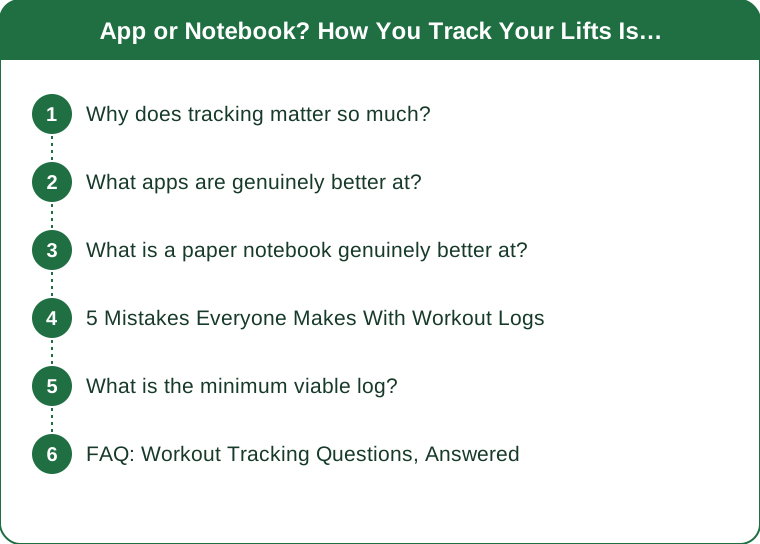
Why does tracking matter so much?
Because progressive overload requires knowing your previous number, and human memory is bad at exactly this task.
The practical failure looks like this: you did 3 sets of 8 at 65lbs three weeks ago. Today you remember it as 70, so you load 70, struggle, and conclude you had an off day. Or you remember it as 60, load 60, and have an easy session that produced no stimulus.
Both are extremely common and both stall progress in the same way - you stop applying a slightly harder load than last time, which is the entire mechanism.
Tracking also does something less obvious: it converts a bad-feeling session into data. A day where everything felt heavy but the numbers matched last week is a good session with bad vibes, and only the log can tell you that.
What apps are genuinely better at?
Four things, and they are real advantages:
- Trend visibility. Seeing that your squat has moved 40lbs in five months is motivating in a way that flipping through notebook pages is not.
- Automatic progression. Many apps suggest the next weight based on your last performance, which removes a decision you would otherwise make while tired.
- Rest timers. Automatic and reliable, which matters more than people think - rest drift is one of the quietest ways a program stops working.
- Exercise history at a glance. Tapping an exercise and seeing your last four sessions takes two seconds.
The cost is the phone. Opening a device that also contains your email and messages between sets is a real focus tax, and gym rest periods stretch from 90 seconds to four minutes without you noticing.
If you go the app route, the single highest-value move is putting the phone in airplane mode or Do Not Disturb for the session.
What is a paper notebook genuinely better at?
Three things:
- Speed at the rack. Writing 65x8 takes about two seconds. Unlocking a phone, finding the app, finding the exercise, and entering it takes fifteen to thirty.
- No notification surface. A notebook has never once shown you a work email between sets.
- Freeform notes. Writing left knee felt off on set 3 in the margin is instant on paper and fiddly in most apps.
The cost is that the data does not aggregate. Finding what you squatted in March means flipping pages, and there is no chart.
A middle path that works well: notebook at the gym, and a five-minute transfer to a spreadsheet on Sunday. You get the speed during the session and the trend view weekly - and the Sunday transfer doubles as a review that most people never otherwise do.

5 Mistakes Everyone Makes With Workout Logs
1. Tracking too much. Logging RPE, rest time, mood, sleep, and bar speed for every set is a system you will abandon in three weeks. Weight, reps, and one optional note is enough for years.
2. Only logging the good sessions. The bad days are the informative ones. A month of complete data beats three months of curated data.
3. Logging afterward from memory. Log between sets. Post-session logging is where the rounding-up happens.
4. Starting a new log every time you change programs. The value compounds across the whole history. Keep one continuous log even when the program changes.
5. Never reading it back. A log you write and never review is a diary, not a tool. Look at the last three sessions before each workout - it takes ten seconds and it decides the weight.
What is the minimum viable log?
Three fields per exercise, and one line per session:
Exercise, weight, reps completed per set. For example: Goblet squat 40 - 10/10/8.
That is it. Everything else is optional.
The one optional field worth keeping is a single sentence per session about anything unusual - poor sleep, a joint that complained, a new shoe. Three months later, that sentence is how you diagnose a pattern that the numbers alone will not show.
And add one habit: circle the number you want to beat next time. It turns a passive record into an instruction, and it means the next session’s decision is already made before you arrive.
The whole thing should take under 90 seconds across an entire workout. If your system takes longer than that, it is too elaborate to survive.
FAQ: Workout Tracking Questions, Answered
Do I need to track cardio too?
Less critically - duration and perceived effort covers most of it. The exception is structured interval work, where the paces or watts matter for the same reason lifting weights do.
What if I train at home with the same few weights?
Tracking matters more, not less. With limited weight jumps, progression comes from reps and tempo, and those are exactly the variables memory is worst at.
How long until the log is useful?
It is useful on session two. It becomes genuinely valuable at about eight weeks, when you can see whether a program is working rather than guessing.
TL;DR:
- Untracked training drifts toward the same weight forever, because memory rounds up.
- Apps win on trends, automatic progression, and rest timers. Notebooks win on speed and on not opening a device full of notifications.
- Notebook at the gym plus a weekly spreadsheet transfer gets both, and the transfer doubles as a review.
- Log weight, reps, and one optional sentence. Nothing more.
- Circle the number to beat next time - it turns the record into an instruction.
The format is genuinely a preference. The tracking is not. Pick the one you will still be doing in two months and stop thinking about it.
See It in Motion
Seen here: Round Neck Long Sleeve Athletic T-Shirt — shop it on bubblelime.com
Keep Reading
This article is for general informational and styling purposes only. Fit, sizing, and product availability may vary.