Why the Gym Feels Freezing in the Cardio Area and Sweltering in the Weight Room
Quick Answer: Many gyms deliberately run cardio zones cooler, since sustained cardio generates more consistent body heat needing more active cooling, while free weight and lifting areas often run slightly warmer to keep muscles and joints ready for explosive movement without needing as much airflow — dressing in easily removable layers, rather than one fixed outfit, is the practical fix for moving between the two.
It’s not inconsistent HVAC — many gyms genuinely set different target temperatures for different zones, based on what the equipment and typical workout style in each area actually demands.

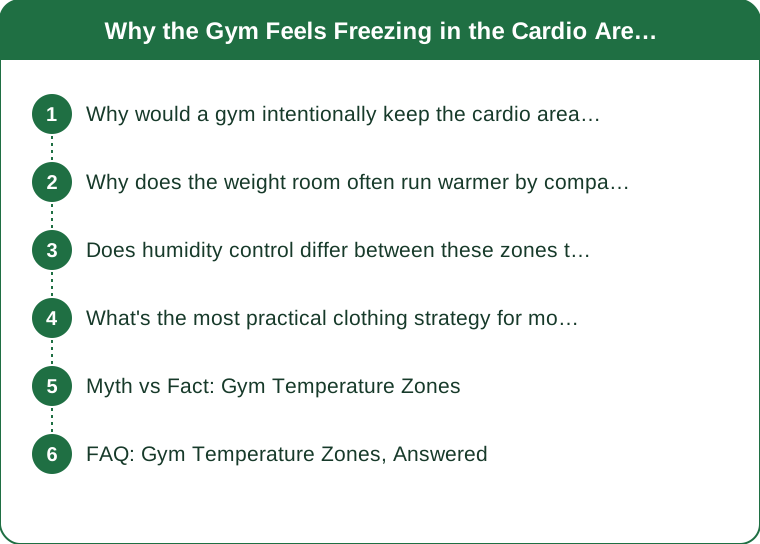
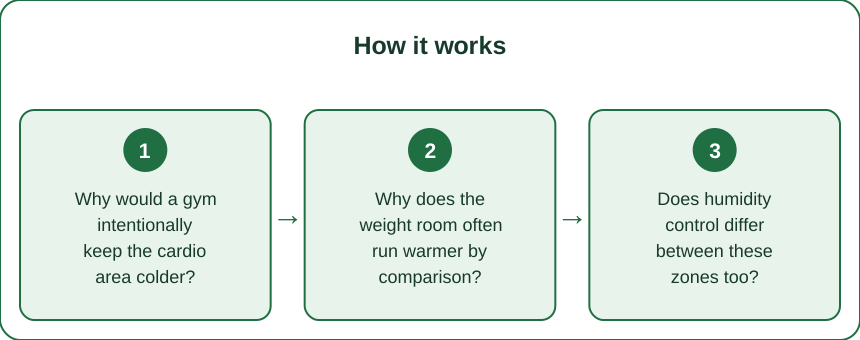
Why would a gym intentionally keep the cardio area colder?
Sustained cardio work generates continuous, elevated body heat and heart rate over longer stretches than typical strength training sets, and gyms often compensate with more aggressive airflow and slightly lower target temperatures in cardio zones specifically to keep that sustained heat output manageable for members and reduce how quickly the space feels overheated during peak hours.
Why does the weight room often run warmer by comparison?
Muscles and connective tissue perform better, with lower injury risk, when adequately warmed, and a slightly warmer ambient temperature supports that for lifting-focused areas where explosive, joint-intensive movements are common. Between-set rest periods in strength training also mean less continuous heat generation than cardio, so a cooler setting isn’t as necessary and can actually work against staying warmed up between sets.
Does humidity control differ between these zones too?
In some gyms, yes — cardio areas with many machines running simultaneously can generate more collective humidity from sweat and breathing, prompting more active dehumidification alongside cooling, while weight rooms with more spread-out equipment and intermittent activity don’t accumulate humidity as quickly.

What’s the most practical clothing strategy for moving between both zones in one session?
A light, easily removable layer — a zip-up or a lightweight jacket you can tie around your waist — lets you adjust quickly between a cooler cardio warmup and a warmer weight room session, rather than committing to one outfit that’s uncomfortable in either zone. Moisture-wicking base layers help regardless of which zone you’re in, since both still involve real sweat output.
Myth vs Fact: Gym Temperature Zones
Myth: Gym temperature differences are just inconsistent HVAC, not intentional. Fact: many gyms deliberately target different temperatures per zone based on typical activity type.
Myth: The weight room being warmer means it’s not being properly cooled. Fact: a slightly warmer target temperature supports muscle readiness for explosive lifts, not a maintenance oversight.
Myth: You should dress for whichever zone you’ll spend the most time in and ignore the other. Fact: a removable layer strategy handles both zones far more comfortably than committing to one fixed outfit.
FAQ: Gym Temperature Zones, Answered
Is it reasonable to ask gym staff about the temperature difference if it feels extreme?
Yes — if the difference feels uncomfortably large rather than mild, staff can usually confirm whether it’s an intentional zone setting or worth reporting as an HVAC issue.
Does gym temperature zoning vary a lot between different gym chains?
Yes, meaningfully — not all gyms zone temperature this deliberately, so the pattern is common but not universal, and some gyms do run one uniform temperature throughout.
Should I warm up in the weight room even if my session starts with cardio?
Not necessarily required, but doing a few minutes of lighter movement before heavy lifting, regardless of the room’s ambient temperature, remains a good practice for injury prevention.
TL;DR:
- Many gyms deliberately run cardio zones cooler to offset the continuous heat generated by sustained aerobic work
- Weight rooms often run slightly warmer to support muscle readiness for explosive, joint-intensive lifts
- Humidity control can also differ between zones based on typical equipment density and activity type
- A removable light layer handles moving between both zones far better than one fixed workout outfit
It’s not your imagination and it’s not broken air conditioning — the two zones are often built around genuinely different physiological demands.
See It in Motion
Seen here: Super High Waist Embossed Yoga Leggings with Inner Pocket — shop it on bubblelime.com
Keep Reading
This article is for general informational and styling purposes only. Fit, sizing, and product availability may vary.