The September Gym Crowd Is Coming — How to Keep Your Routine
Quick Answer: Gym traffic spikes in the first two weeks of September as school schedules resume and summer memberships convert to routines. The reliable defenses are structural rather than heroic: shift your session 30 to 45 minutes earlier or later than the new peak, build a machine-flexible plan where every exercise has a substitute, use supersets so you occupy one station instead of waiting for two, and accept a shorter, denser session over a skipped one. Crowds thin out by early October in most gyms.
You spent July with the squat rack to yourself. Then the first Tuesday after Labor Day arrives and there is a line.

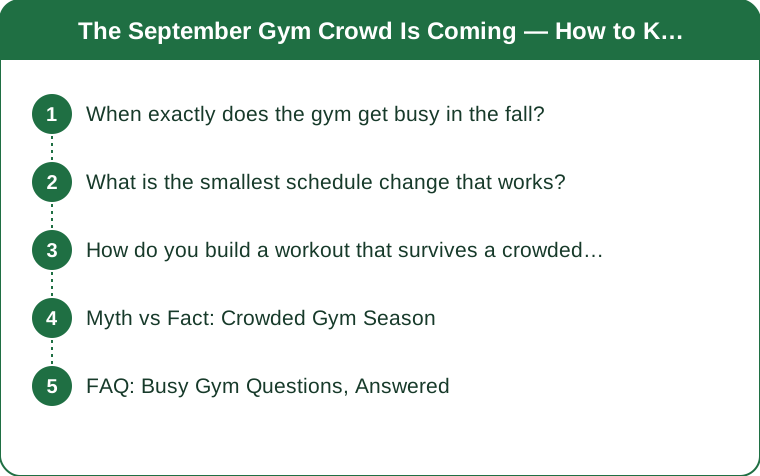
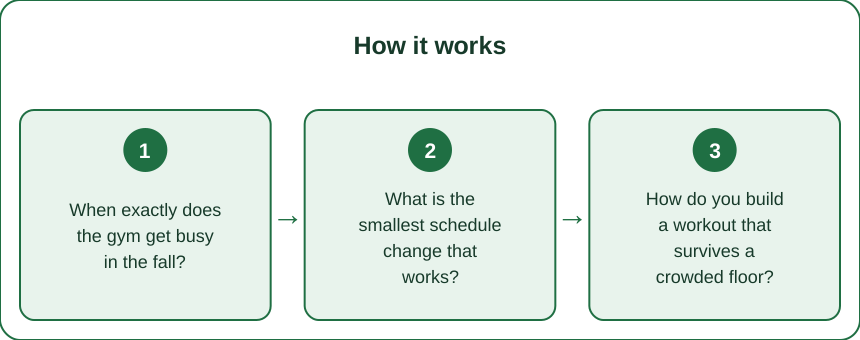
When exactly does the gym get busy in the fall?
The pattern is remarkably consistent across commercial gyms. The first full week after Labor Day brings the sharpest jump, driven by parents whose kids are back in school and by people treating September as a second January.
Peak hours shift too. Summer peaks tend to be spread out because schedules are loose. Fall peaks are sharp: 6 to 8 a.m. and 5 to 7 p.m., tied to school drop-off and standard work hours.
The encouraging part is that the surge is temporary. Attendance typically thins noticeably by mid-October as the newest members fall away, and the people still there in November are the ones who were always going to stay.
So you are managing roughly five to six weeks of congestion, not a permanent change. That framing matters, because the temptation is to make a dramatic decision — cancel the membership, buy home equipment, switch to running — in response to a temporary condition.
What is the smallest schedule change that works?
Usually 30 to 45 minutes, in either direction.
Moving from 6:00 p.m. to 6:45 p.m. sounds trivial, but peak density is narrow. The 5-to-6:30 block is where the crush lives, and the back half of the evening empties fast. The same applies in the morning: 5:30 a.m. is a completely different gym from 6:30 a.m.
If you have any flexibility at all, the best-kept quiet windows are 10 a.m. to 2 p.m. on weekdays and late morning on Saturdays, since most people assume weekend mornings are packed and arrive early.
One more option people forget: Friday evening. It is consistently the least crowded weekday evening in almost every gym, by a wide margin.
Before you rearrange anything, check whether your gym app shows live occupancy. Many chains do now, and two weeks of glancing at it tells you more about your specific location than any general rule. Your gym is not the average gym, and the quiet window might be somewhere nobody would guess.

How do you build a workout that survives a crowded floor?
The core idea is substitutability. Write your plan so that every exercise has a listed alternative that trains the same thing on different equipment.
Barbell back squat is busy? Goblet squat or leg press. Bench press taken? Dumbbell press or a machine chest press. Cable row occupied? Chest-supported dumbbell row. Write the substitutes into your notes app before you walk in, because deciding under social pressure while someone hovers is how people end up doing a random assortment of whatever was free.
Supersets are the other half. Pairing two exercises that use the same station — or a station plus a bodyweight movement — means you hold one piece of equipment instead of waiting for two, and your session gets shorter. Squat and push-up. Dumbbell row and dumbbell curl at the same bench. Leg press and calf raise on the same machine.
Also: do the crowded thing first. If the one exercise you genuinely cannot substitute is the barbell hip thrust, do it at minute three when you have energy and patience, not at minute forty when you are tired and the queue is four deep.
Myth vs Fact: Crowded Gym Season
Myth: You need to arrive earlier to beat the crowd. Fact: Earlier is where everyone else moves too. Later is usually the emptier direction in the evening, and often in the morning as well.
Myth: A crowded gym means a worse workout. Fact: Crowds mostly cost you time and equipment choice, not stimulus. A dense 35-minute session with substitutions produces essentially the same result as a leisurely 60-minute one.
Myth: It is rude to ask to work in. Fact: Working in is standard gym practice and almost everyone says yes. The socially awkward part is entirely in your head — the person on the bench is usually relieved to have the rest interval structured.
Myth: You should switch to home workouts for September. Fact: Habit disruption is the actual risk. People who pause their gym routine for a busy month often do not restart it, and the crowd was going to disappear anyway.
Myth: New members will ruin the equipment culture. Fact: Most of them were you, once. The plate-loading and re-racking issues resolve as people learn, and being visibly gracious about it is more useful than being annoyed.
FAQ: Busy Gym Questions, Answered
How do I politely ask to work in?
Wait for the person to finish a set, make eye contact, and say some version of: mind if I work in? Then actually work in — do your set during their rest, and reset the weight to theirs when you finish. It takes one exchange to become completely normal.
What if all the racks are taken for the whole session?
Have a plan B day written out — a full dumbbell-and-machine session that needs no rack at all. Knowing you have one removes the anxiety of walking in on a packed evening, which is often the real barrier.
Is it worth switching gyms during the fall rush?
Rarely, unless the crowding is chronic rather than seasonal. Give it until mid-October before judging your gym by its September.
How do I protect my consistency if I can only get 30 minutes?
Cut exercises, not sessions. Two compound movements done well beat a full program done never. Showing up short is the behavior that keeps the habit alive through the busiest weeks.
TL;DR:
- Gym traffic peaks in the first two weeks after Labor Day and usually thins by mid-October — you are managing five or six weeks, not a new normal.
- Shift your session 30 to 45 minutes later, and try Friday evenings or weekday late mornings.
- Write substitutions for every exercise before you walk in, and do the un-substitutable movement first.
- Use supersets to hold one station instead of waiting for two.
- On a bad night, cut exercises rather than skipping — a short session protects the habit.
The crowd is annoying and it is also temporary. The people who are still there in November are the ones who adapted for six weeks instead of opting out — and that is a much smaller ask than restarting in January.
See It in Motion
Seen here: Racerback Tank Top - White — shop similar styles on bubblelime.com
Keep Reading
This article is for general informational and styling purposes only. Fit, sizing, and product availability may vary.