Why You Are Weaker Some Days - and What It Actually Means
Quick Answer: Daily strength varies meaningfully with sleep, food, hydration, stress, time of day, and where you are in your training week - a swing of several percent either way is entirely normal in a healthy, well-trained person. An off day is data about your week, not about your progress. The mistake is training as though every day should be your best one.
You did not lose strength between Tuesday and Thursday.
You slept badly, ate late, and had a difficult week, and your body priced that in.

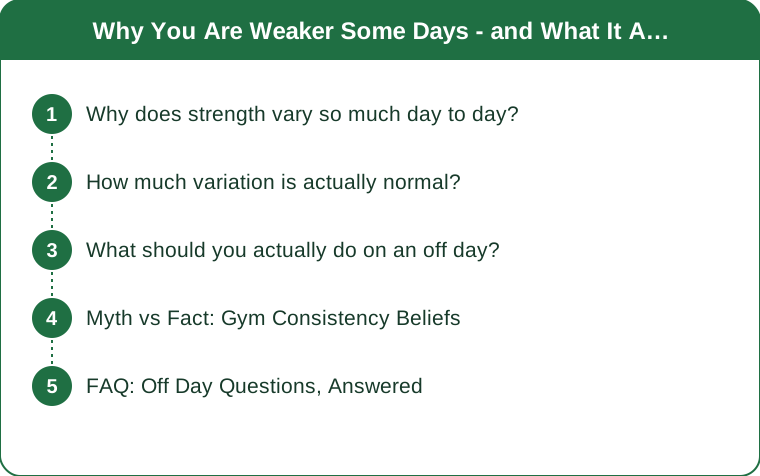
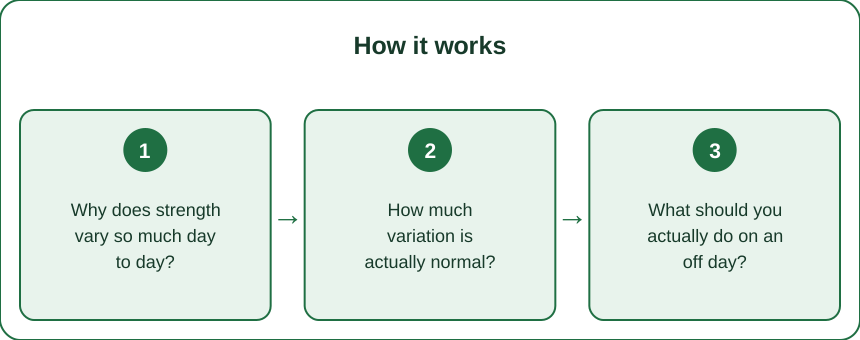
Why does strength vary so much day to day?
Because performance depends on far more than muscle.
Sleep is the largest single factor for most people. A short or broken night reduces force output, reaction time, and motivation simultaneously. One bad night is felt in the gym, and two are felt considerably more.
Fuel and hydration move the number too. Training under-fuelled or mildly dehydrated raises perceived effort and lowers output, particularly for longer sets. A rushed day with a skipped lunch shows up on the bar.
Stress is physiological, not just psychological. A high-stress week affects recovery, sleep, and how ready your nervous system is to produce force. Your body does not separate work stress from training stress - it just adds them.
Time of day matters more than people expect. Most people are measurably stronger in the late afternoon than early morning, largely due to body temperature and hormonal patterns. A six a.m. session is not comparing like with like against a five p.m. one.
Where you are in the training week matters. Squatting two days after a hard leg session is a different proposition from squatting five days after. Accumulated fatigue is the intended cost of a well-planned week, not a failure.
And the menstrual cycle affects some people noticeably. Experiences vary a great deal, but many people report clear patterns in energy and strength across the cycle. Tracking it for two or three months tells you far more than any general rule.
How much variation is actually normal?
More than most beginners assume, and it is worth knowing your own range.
A swing of a few percent day to day is unremarkable. On a moderate lift that can mean a visible difference in the weight on the bar, which feels dramatic and is statistically ordinary. The bar makes small changes look large.
Rep quality is a better gauge than the weight itself. The same load moving slowly and with effort is a lower-capacity day than the same load moving crisply. Speed and feel tell you more than the number does.
A single bad session means almost nothing. Progress is measured over weeks, and one session is heavily influenced by the previous forty-eight hours. Never draw a conclusion from one day.
Three bad sessions in a row is a signal. That is long enough to suggest accumulated fatigue, under-recovery, or an under-eating pattern rather than random variation. The response is usually a lighter week, not more effort.
Novices vary more. Early on, technique consistency swings results considerably, so a beginner’s day-to-day variation includes a large skill component. It settles as the movement becomes automatic.
And a persistent decline over weeks is worth investigating. Strength trending down across a month with adequate food and sleep is not normal variation. That is worth mentioning to a doctor rather than training through. This is general information, not medical advice.

What should you actually do on an off day?
Adjust the session rather than abandoning it or forcing it.
Autoregulate the load. Work up to your planned weight and if it moves badly, reduce it and do the planned reps at a manageable load. A completed session at eighty percent beats a failed one at a hundred.
Keep the volume, drop the intensity. The same number of sets and reps at a lighter load maintains the training habit and the movement practice without digging a hole. Volume is where much of the benefit lives anyway.
Do not test your maximum on a bad day. Testing when under-recovered gives you a misleading number and a large recovery cost. Save testing for a day you feel good, and plan it in advance.
Consider what caused it before changing your programme. Sleep, food, stress, and cycle explain the large majority of off days. Changing your programme after one bad session is a reliable way to never progress at anything.
Use it as information about the week. If Thursdays are consistently bad, look at Wednesdays - late meetings, poor sleep, or a hard session. Patterns are more useful than individual days.
And leave the gym rather than grinding when something hurts. Off days and pain days are different, and pain that is sharp, joint-based, or one-sided is not a fatigue signal. Stopping is the right call, and persistent pain deserves assessment.
Myth vs Fact: Gym Consistency Beliefs
Myth: if you are training properly, every session should be better than the last. Fact: progress is a trend line through a noisy scatter, not a staircase. Expecting linear improvement is the fastest way to feel like a failure while making steady progress.
Myth: an off day means you need to push harder. Fact: an off day is usually a recovery signal, and pushing through it deepens the deficit. Harder is the wrong response to under-recovery, reliably.
Myth: real lifters do not have bad days. Fact: experienced lifters have as many bad days and simply respond to them differently. The skill is the response, not the absence of them.
Myth: you should never reduce the planned weight. Fact: adjusting the load to the day is a standard, well-established practice with a name - autoregulation. It is a technique, not a concession.
Myth: caffeine fixes an off day. Fact: it can mask fatigue for an hour and does nothing about the underlying cause, and it can worsen the sleep that caused the problem. It borrows against tomorrow.
Myth: taking a rest day sets you back. Fact: adaptation happens during recovery, not during the session, and a well-timed rest day usually produces a better week. Rest is part of the training, not a gap in it.
FAQ: Off Day Questions, Answered
Should I still go if I feel weak before I start?
Usually yes - a warm-up frequently changes the picture entirely, and the first set is a poor predictor. Decide after fifteen minutes, not before you leave the house.
How do I tell an off day from overtraining?
Duration and pattern. One or two bad sessions is normal; several weeks of declining performance with poor sleep and low motivation is a different picture and worth taking seriously.
Is it worth tracking how I feel each session?
A one-to-ten note takes five seconds and reveals patterns you would never spot otherwise. Most people discover a weekday pattern within a month of doing it.
TL;DR:
- Daily strength swings by a few percent with sleep, fuel, stress, time of day, and weekly fatigue.
- Rep speed and feel are better gauges than the number on the bar.
- One bad session means nothing; three in a row is a signal - and the answer is usually a lighter week.
- Autoregulate: keep the volume, drop the load, and never test a maximum on a bad day.
- Look at yesterday before changing your programme - the cause is nearly always in the previous forty-eight hours.
Add a one-to-ten note to your training log this week. Within a month you will know which day of your week is quietly costing you sessions.
See It in Motion
Seen here: Racerback Tank Top - White — shop similar styles on bubblelime.com
Keep Reading
This article is for general informational and styling purposes only. Fit, sizing, and product availability may vary.