Why the Jump From 20 to 25 Pounds Feels Impossible
Quick Answer: A 20 to 25 lb dumbbell jump is a 25 percent load increase in a single step — the equivalent of a barbell lifter going from 100 to 125 lb overnight. It is not a strength problem, it is a rack resolution problem. The fixes are real: add reps and sets before adding weight, use tempo and pauses, mix pairs, or use small add-on weights. Progressive overload does not require a bigger dumbbell.
You have been doing 20 lb dumbbell presses for a month, they feel comfortable, and the next dumbbell on the rack might as well be a car.
This is a genuine structural problem with dumbbell racks, not a plateau. The second section has the number that explains why it feels the way it does.

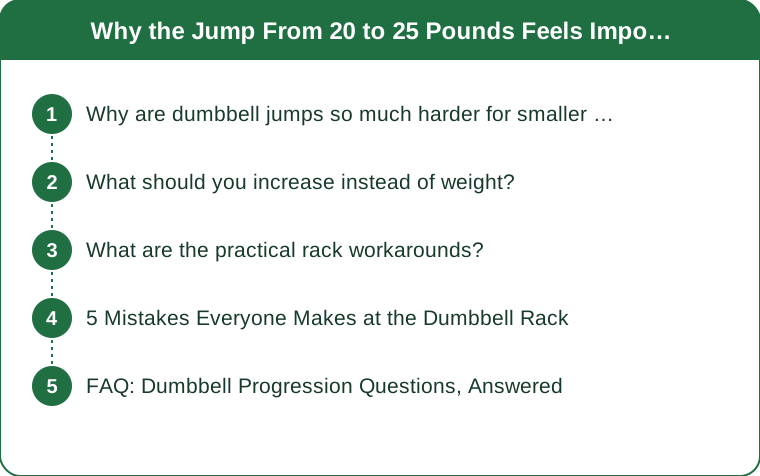
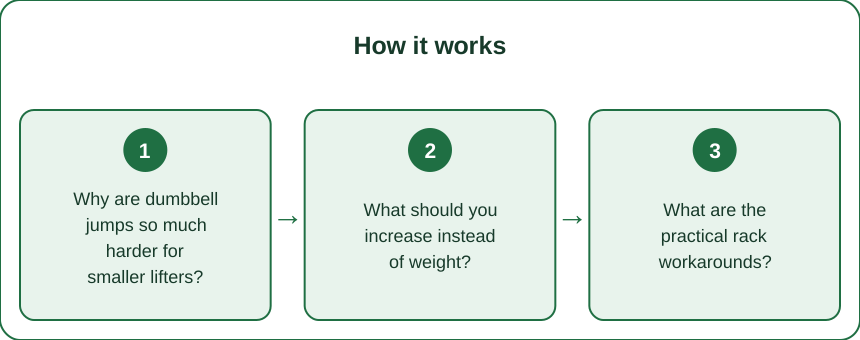
Why are dumbbell jumps so much harder for smaller lifters?
Because the rack increments are absolute and your strength is proportional.
Most commercial racks jump in 5 lb steps (or 2 to 2.5 kg), and they do it uniformly from the bottom to the top. That means:
From 10 to 15 lb: a 50 percent increase. From 20 to 25 lb: a 25 percent increase. From 50 to 55 lb: a 10 percent increase. From 90 to 95 lb: a 5.5 percent increase.
The same rack that offers a 5 percent progression to a strong lifter offers a 25 percent one to you. A typical, well-tolerated progression in strength training is in the range of 2 to 10 percent per step. A 25 percent jump is far outside it, and a 50 percent jump is not a progression at all, it is a different exercise.
This is not a minor inconvenience. It is the single most common reason people get stuck on dumbbell movements, and it disproportionately affects smaller and newer lifters — which means it lands hardest on exactly the people most likely to interpret it as a personal failing.
Some gyms make it worse. Racks that jump 10 lb above 30, or that are missing sizes entirely, produce gaps that are effectively impassable without a strategy. If your gym’s rack skips from 25 to 35, that is a 40 percent jump and no amount of trying harder will bridge it.
What should you increase instead of weight?
There are five variables, and load is only one of them.
1. Reps. The simplest and most reliable. If you are pressing 20 lb for 3 sets of 8, build to 3 sets of 12 before touching the next dumbbell. By the time you can do 12 clean reps, the jump to 25 for 6 to 8 reps is manageable. This is called double progression and it exists precisely because of this problem.
2. Sets. Adding a fourth set at the same weight increases total volume, which is a primary driver of adaptation. Three sets of 10 to four sets of 10 is a 33 percent increase in work done, with no rack required.
3. Tempo. Slowing the lowering phase to three or four seconds dramatically increases time under tension and the eccentric load. A 20 lb dumbbell lowered over four seconds is meaningfully harder than one lowered over one.
4. Pauses. A two-second pause at the hardest point of the range — the bottom of a press, the bottom of a squat — removes the stretch reflex and makes the same weight considerably more demanding.
5. Range of motion and stability. Moving from a bench to a single-arm version, or from two feet to a split stance, increases the demand at the same load. Single-arm work also lets you use a heavier dumbbell than a pair would allow, since you are stabilizing rather than pressing two.
Sequence them: reps first, then sets, then tempo or pause, then weight. This gives you eight to twelve weeks of progression between rack steps instead of an impassable wall.

What are the practical rack workarounds?
Four, in order of how easily you can start using them today.
1. Mixed pairs — use one of each. For exercises where each arm works independently — presses, rows, curls, lunges — use a 20 and a 25 and alternate which side gets the heavier one between sets. Your total load has increased by 12.5 percent instead of 25 percent. It looks slightly odd and it works perfectly. Just make sure the sides get equal treatment across the session.
2. Microloading with add-on weights. Magnetic add-on plates in 1.25 to 2.5 lb increments stick to the ends of a dumbbell and cost very little. They convert every 5 lb jump into two or four steps. If you train regularly, this is the highest-value small purchase available. Ankle weights wrapped around the handle work in a pinch.
3. Use adjustable dumbbells if your gym has them — some have 2.5 lb increments, and many home setups do. If you train at home, an adjustable set with small increments solves this problem permanently.
4. Use cables or machines for the exercises where the gap is worst. Cable stacks often have smaller increments and many have add-on micro plates. There is no rule that a given muscle must be trained with a dumbbell. If the dumbbell jump is blocking your progress on one movement, use a machine version for a block and come back.
And one framing point: the strongest people in the gym have this problem too, they just meet it at 100 lb rather than 25. Everyone hits rack resolution eventually, and everyone solves it with the same tools.
5 Mistakes Everyone Makes at the Dumbbell Rack
Mistake 1: Interpreting the gap as a plateau. It is a measurement problem. You are almost certainly still getting stronger — the equipment simply cannot show it in 5 lb steps. Track reps and total volume rather than only the number on the dumbbell, and the progress becomes visible again.
Mistake 2: Jumping anyway and losing form. Grabbing the 25 and grinding out five ugly reps with a shortened range trains a worse movement pattern and increases injury risk. A clean set at 20 builds more than a compromised set at 25.
Mistake 3: Ping-ponging between weights every session. 20 one week, 25 the next, back to 20, never establishing anything. Pick one and progress it deliberately for three to four weeks.
Mistake 4: Never writing anything down. Without a log, the only progress marker available is the dumbbell number — which is exactly the marker that cannot move. A notebook or an app that records weight, sets, and reps makes rep progression visible, and visible progress is what sustains the habit.
Mistake 5: Assuming heavier is always the goal. For a lot of goals — muscular endurance, general strength, body composition, joint health — total volume and consistency matter more than the specific load. Progression is the point, not the number on the dumbbell. The 20 lb dumbbell you use for four sets of twelve with a three-second lower is doing plenty of work.
FAQ: Dumbbell Progression Questions, Answered
How many reps should I get to before increasing weight?
A widely used approach is a rep range with a top and bottom — for example 8 to 12. Start at the bottom of the range with a new weight, build to the top across weeks, then increase the weight and drop back to the bottom. For a 25 percent jump you may want to build past the top of the range, to 14 or 15 reps, before stepping up.
Are magnetic add-on weights actually worth buying?
If you train with dumbbells more than once a week, yes — they are inexpensive, portable, and they turn an impassable 25 percent jump into a comfortable 5 or 10 percent one. They are also the only fix that works at every rack you will ever use. Check they fit the handle style at your gym before buying.
Should I switch to barbells to get smaller increments?
Barbells do solve the increment problem elegantly — plates go down to 1.25 kg or 2.5 lb per side — and that is a legitimate reason to include barbell work. But dumbbells have real advantages in range of motion, unilateral balance, and shoulder-friendly positioning. Use both rather than switching, and let the barbell carry the movements where fine increments matter most.
TL;DR:
- A 20 to 25 lb jump is a 25 percent load increase — far outside the 2 to 10 percent that progresses well.
- It is a rack resolution problem, not a plateau; strong lifters hit the same wall at 100 lb.
- Progress reps first, then sets, then tempo and pauses, and only then weight.
- Use mixed pairs, magnetic add-on plates, adjustable dumbbells, or cables to bridge the gap.
- Log your sets — without a log, the only visible marker is the one number that cannot move.
The reason this one is worth understanding is that it removes an entirely fake ceiling. A lot of people quietly conclude they have stopped getting stronger somewhere around the 20 lb dumbbell, when what actually happened is that the next available measurement was 25 percent away and nobody mentioned that this was a hardware limitation.
See It in Motion
Seen here: UPF 50+ Racerback Yoga Tank Top — shop it on bubblelime.com
Keep Reading
This article is for general informational and styling purposes only. Fit, sizing, and product availability may vary.