What a Deload Week Actually Looks Like in a Normal Gym Routine
Quick Answer: A deload is a planned week of reduced training stress, not a week off. The most reliable version keeps the same sessions and the same movements, cuts the number of working sets by roughly half, and drops load to about sixty to seventy percent of your normal working weight. Keep the frequency and the movement patterns; cut volume first and intensity second. Most people need one every four to eight weeks, and the signal to take it arrives before performance drops.
The part that trips people up is that a deload should feel easy and still feel like training.
We have covered progressive overload basics, plateau breakthroughs and off-day strength fluctuation. This is the week that makes all three work.

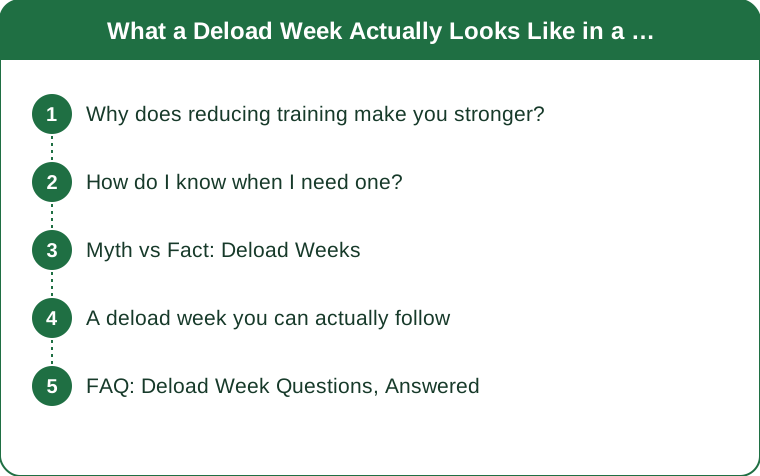
Why does reducing training make you stronger?
Because adaptation happens during recovery and accumulated fatigue hides the fitness you have already built.
Training produces two things at once: fitness and fatigue. Fitness builds slowly and lasts; fatigue builds quickly and fades quickly.
Performance on any given day is roughly fitness minus fatigue. Which means a week of high fatigue can completely mask several weeks of genuine progress.
Cutting the load lets fatigue drop while fitness stays. Fitness decays over weeks; fatigue decays over days, which is why one lighter week reveals the gains rather than losing them.
Connective tissue gets the recovery it actually needs. Tendon and joint structures adapt more slowly than muscle, and a deload is often the only point at which they catch up.
The nervous system recovers too. Persistent heavy training dulls force production in ways that feel like weakness and are actually fatigue.
And it resets the psychological load. A week where nothing is a grind restores the willingness to push, which is a real training variable even if it does not appear in a program.
How do I know when I need one?
The signals appear before performance drops, and most of them are not about the gym.
Warmup sets feeling heavy is the earliest reliable sign. The weights that normally disappear start to register, which is fatigue rather than lost strength.
Sleep quality dropping while training hard is a classic marker, particularly waking in the early hours.
Losing interest in sessions you normally look forward to. Motivation decline tracks accumulated fatigue closely and shows up sooner than any lift number.
Elevated resting heart rate, if you happen to track it, of about five beats or more above your usual for several days.
Little niggles multiplying. Not injuries, just a shoulder that talks, a knee that clicks, an elbow that grumbles. Three of these at once is a message.
And the schedule matters as much as the symptoms. Most people running a structured program need a deload every four to eight weeks, and taking it on schedule beats waiting for the signals, which arrive later than is ideal.

Myth vs Fact: Deload Weeks
Myth: A deload means taking the week off. Fact: Complete rest is a different tool. A deload keeps the movement patterns and the habit intact while removing the stress, which recovers you without losing the groove or the routine.
Myth: You will lose strength. Fact: Measurable strength loss takes considerably longer than a week of reduced training. Most people come back from a deload lifting more, because the fatigue masking their strength has cleared.
Myth: Deloads are only for advanced lifters. Fact: Advanced lifters need them more often because they generate more fatigue per session. Beginners need them less often and still benefit, particularly for connective tissue that is adapting to loading for the first time.
Myth: You should cut intensity, not volume. Fact: Volume is the bigger driver of fatigue. Cutting sets while keeping some heavier work maintains the neural pattern better than doing the same number of sets with light weights.
Myth: A deload week is wasted training. Fact: It is the week the previous four turn into results. Adaptation happens in recovery, and permanently under-recovering means permanently under-adapting.
Myth: You will lose your momentum and not come back. Fact: This is the real risk and it is a habit problem, not a physiology one. Keeping the same days, the same gym times and the same movements is exactly what prevents it, which is why a deload beats a week off for most people.
A deload week you can actually follow
Six rules that turn the concept into a schedule.
Keep every session and every day. Same days, same times, same movements. Only the numbers change.
Halve the working sets. If you normally do four sets of squats, do two. This is the single most effective change and the one most people skip.
Drop the load to about sixty to seventy percent of your normal working weight. It should feel genuinely easy — you should finish every set knowing you had five or more reps left.
Keep one or two heavier singles or doubles if you like, well short of maximum, purely to keep the pattern sharp. Optional, and useful for anyone who feels rusty coming back.
Do not add cardio to fill the time. The point is reducing total stress, and replacing lifting fatigue with conditioning fatigue defeats it.
And leave the gym feeling like you could do the whole session again. That is the calibration. If you finished tired, it was not a deload.
One thing to protect: sleep and food stay the same. Deloading training while also cutting calories or sleep removes most of the recovery you were trying to create. If anything, this is the week to sleep more.
FAQ: Deload Week Questions, Answered
How often should I deload?
Every four to eight weeks for most people running a structured program, more often the more advanced and the higher the training volume. Taking it on schedule works better than waiting for symptoms, since the signals tend to arrive later than the point at which you would have benefited.
Will I lose strength during a deload week?
Almost certainly not. Measurable strength loss takes considerably longer than a week of reduced volume. Most people return stronger, because accumulated fatigue clears and reveals fitness that was already there.
What is the difference between a deload and a rest week?
A deload keeps the sessions, the days and the movements while cutting volume and load. A rest week removes training entirely. The deload preserves the habit and the movement pattern, which is why it suits most people better than complete rest.
TL;DR:
- A deload reduces training stress; it does not remove training. Keep the days and the movements.
- Halve your working sets and drop to about sixty to seventy percent of normal load.
- Fatigue clears in days, fitness decays over weeks — which is why you come back stronger.
- Take it on schedule every four to eight weeks rather than waiting for something to hurt.
You should leave every deload session feeling like you could do it all again. That is the whole calibration.
See It in Motion
Seen here: High Waist Yoga Leggings with Side Pockets — shop it on bubblelime.com
Keep Reading
This article is for general informational and styling purposes only. Fit, sizing, and product availability may vary.