Why the Gym Feels Completely Different in September
Quick Answer: September brings the year’s second-largest membership surge after January, plus students returning and summer outdoor exercisers moving indoors. Peak hours get 20 to 40 percent busier for roughly six weeks. The workaround is not to fight it — shift your session by 45 minutes, build a program that tolerates equipment substitution, and expect the crowd to thin substantially by mid-October.
You walk in at your usual time and every squat rack is taken by someone you have never seen before. This happens every year and it follows a predictable curve.

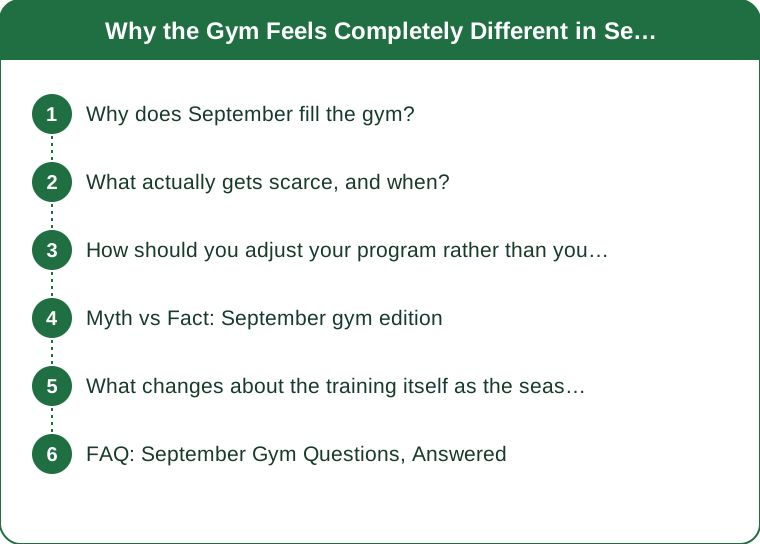
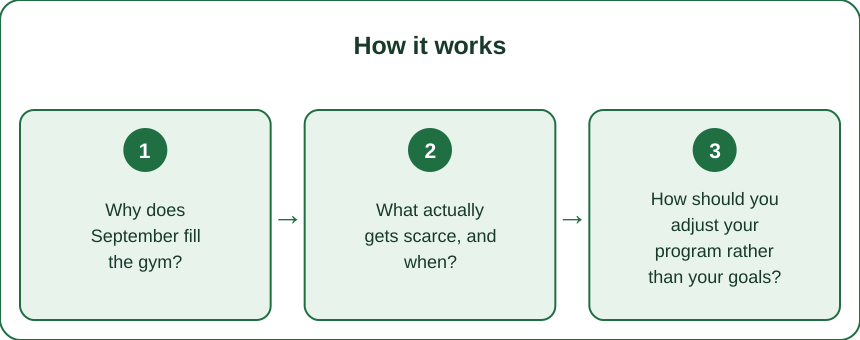
Why does September fill the gym?
Three groups arrive at once. Students return to campus and to campus-adjacent gyms. Parents get their schedules back once school starts. And everyone who spent the summer running, hiking, or cycling outdoors comes back inside as daylight shortens and mornings cool.
The surge is real but shorter-lived than January’s. Historically, September crowds peak in the second and third weeks and normalize substantially by mid-to-late October, whereas January’s surge stretches into February.
The practical implication is that this is a temporary problem with a known end date, which changes how you should respond. Rearranging your whole training approach for six weeks is usually not worth it; small adjustments are.
What actually gets scarce, and when?
Squat racks and benches first, because they are the fixed bottleneck — a gym can have twenty dumbbells and only four racks.
Cardio machines next, particularly in the 5 to 7 p.m. window and on rainy days when outdoor runners come inside.
Dumbbells in the 15 to 35 pound range are the quiet third shortage, because that band covers the largest number of users across the widest range of exercises.
Peak congestion is 5:30 to 7 p.m. on Monday through Wednesday. Thursday evening is noticeably lighter, Friday evening is the easiest weekday slot by a wide margin, and Sunday mid-morning is usually the quietest weekend window.
How should you adjust your program rather than your goals?
Build substitutions in advance. For every exercise in your program, know the alternative you will do if the equipment is taken — a goblet squat for a back squat, a floor press for a bench press, a dumbbell RDL for a barbell one.
Switch to supersets that use one station. Pairing two exercises you can do in the same spot means you claim the space once rather than fighting for two.
Consider moving your accessory work to the beginning during peak weeks. If the rack is taken, doing your accessories first and squatting later is a much better outcome than waiting 15 minutes and rushing everything.
And shift your time rather than your day. Arriving 45 minutes earlier or later than your usual slot usually cuts the wait dramatically, because everyone’s usual time is clustered.

Myth vs Fact: September gym edition
Myth: New members will quit in two weeks so just wait it out. Fact: September retention is meaningfully better than January’s, partly because the trigger is a schedule change rather than a resolution. Expect a real reduction, not a collapse.
Myth: Training at 5 a.m. is the only escape. Fact: Early mornings fill up in September too. Late evening after 8 p.m. and mid-afternoon are usually emptier and less punishing on your sleep.
Myth: You need the exact equipment your program specifies. Fact: Muscles respond to tension and effort, not to specific implements. A well-executed substitute is worth far more than a perfect exercise you waited 15 minutes for.
Myth: The gym raises prices in September. Fact: September is often a promotional month, which is part of why the surge happens. If your membership is up for renewal, it is a decent time to ask about rates.
What changes about the training itself as the season turns?
The gym gets cooler, and most facilities do not adjust their thermostat until well into October. A gym that was pleasantly cool in August can be genuinely cold at 6 a.m. in late September.
That means longer warm-ups. The same rule that applies outdoors applies to an under-heated gym — muscle temperature takes longer to reach, so add several minutes of general work before your first build-up set.
Layer for the first 15 minutes. A long-sleeve you take off after your warm-up sets is not a fashion decision, it is the reason your first working set feels like your third.
This is also the natural point to shift emphasis. If your summer training was cardio-heavy because you were outdoors, September is a sensible time to add a strength block while the outdoor conditions deteriorate anyway.
FAQ: September Gym Questions, Answered
When exactly does it thin out?
Most gyms report a noticeable drop by the fourth to sixth week after the surge starts, so mid-to-late October for a September wave.
Should I switch gyms if mine is unbearable?
Probably not on a six-week basis. If congestion is a year-round problem rather than a seasonal one, that is a different conversation.
How do I handle sharing equipment gracefully?
Ask to work in, and mean it — most people say yes. Strip your plates when you finish, and do not sit on a bench between sets scrolling. Those two habits make you the person everyone is happy to share with.
TL;DR:
- September is the year’s second membership surge, peaking in weeks two and three.
- Racks and benches go first, then cardio, then mid-range dumbbells.
- Plan substitutions and single-station supersets rather than waiting.
- Shift your time by 45 minutes, layer up for a cooler gym, and expect relief by mid-October.
The six weeks are annoying and finite. The people who lose ground are the ones who let a crowded room turn into three skipped sessions a week, and that is entirely avoidable with a substitution list written before you walk in.
See It in Motion
Seen here: Super High Waist Embossed Yoga Leggings with Inner Pocket — shop it on bubblelime.com
Keep Reading
This article is for general informational and styling purposes only. Fit, sizing, and product availability may vary.