Why the Gym Mirror Makes Beginners So Self-Conscious (And How to Actually Get Past It)
Quick Answer: Gym mirror self-consciousness usually comes from the mistaken assumption that other people are watching and judging as closely as you’re watching yourself, when in reality most gym-goers are focused inward on their own workout and barely register anyone else — reframing the mirror as a form-check tool rather than an audience, and choosing off-peak hours early on, both genuinely help.
The mirrors are there for checking squat depth and deadlift form, but for a lot of beginners they become a spotlight that makes every rep feel watched. The good news is the actual math of who’s paying attention is almost always in your favor.

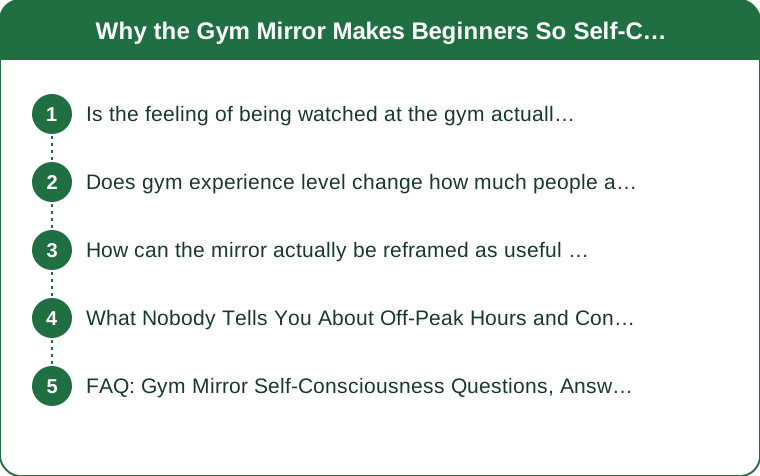
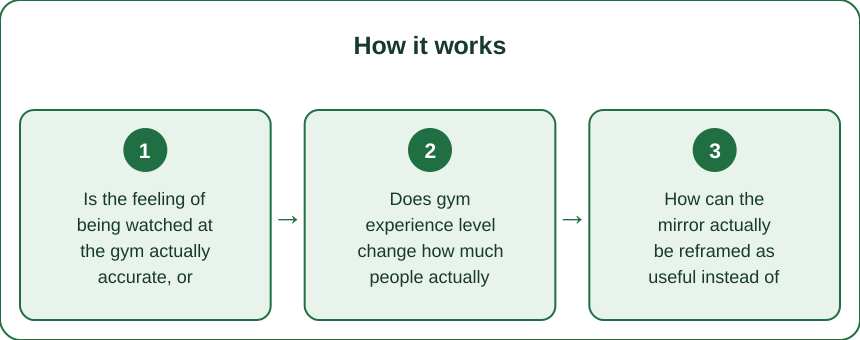
Is the feeling of being watched at the gym actually accurate, or mostly perception?
Almost entirely perception — this is a well-documented psychological pattern sometimes called the spotlight effect, where people significantly overestimate how much others notice and remember about them. In a gym specifically, most regular gym-goers are deep in their own training focus, tracking their own reps and form, and genuinely aren’t watching or judging others the way it feels like they are from the inside.
Does gym experience level change how much people actually notice others?
If anything, more experienced gym-goers notice others even less, since their focus during a working set is almost entirely internal — on their own breathing, bar path, and effort level. The people most likely to glance around are often other beginners feeling similarly self-conscious, which means the ‘audience’ most new gym-goers imagine is largely made up of people equally focused on themselves.

How can the mirror actually be reframed as useful instead of intimidating?
Treating it purely as a form-check tool — glancing to verify knee tracking during a squat or back position during a deadlift, then looking away — shifts its function from a source of self-judgment to a practical training aid, which is genuinely what it’s there for. Some people find it easier to build this habit by initially avoiding direct eye contact with their own reflection and just checking specific body positions instead.
What Nobody Tells You About Off-Peak Hours and Confidence Building
Choosing quieter gym hours (often mid-morning or early afternoon on weekdays) while building initial comfort with the space and equipment isn’t avoidance — it’s a reasonable strategy that lets new gym-goers focus on learning movements and building a routine without the added social pressure of a packed, high-energy peak hour. Many people naturally become comfortable enough to work out at busier times once the fundamentals feel familiar.
FAQ: Gym Mirror Self-Consciousness Questions, Answered
Should I just avoid mirrors entirely if they make me anxious?
You don’t have to face them directly if it’s genuinely distressing, but mirrors do offer real form-check value — a middle ground of quick, purposeful glances rather than avoidance or constant self-watching tends to work well for most people over time.
Does this self-consciousness usually fade with experience?
Yes, for the large majority of people — familiarity with the space, the equipment, and your own routine steadily reduces the self-conscious feeling, and it’s a genuinely common phase rather than a personal shortcoming.
Are there specific gym layouts or times that reduce this feeling faster?
Smaller studio gyms or off-peak hours at larger gyms both tend to reduce the intensity of feeling watched, simply because there are fewer people and less visual stimulation overall while you’re building comfort.
TL;DR:
- The feeling of being watched at the gym is mostly the spotlight effect, not accurate perception
- Experienced gym-goers are usually the least likely to be watching others during their own sets
- Using the mirror for quick form checks reframes it as a tool rather than a source of judgment
- Off-peak hours are a reasonable, non-avoidant strategy for building comfort early on The mirror was never actually the audience it felt like — treating it as a form-check tool instead of a stage is often the exact shift that makes the gym feel workable.
See It in Motion
Seen here: Crewneck Short Sleeve Workout T-Shirt — shop it on bubblelime.com
Keep Reading
This article is for general informational and styling purposes only. Fit, sizing, and product availability may vary.