The Unwritten Gym Machine Queue Rule Nobody Explains to First-Timers
Quick Answer: The standard etiquette for a busy machine is to ask to “work in” — alternating sets with whoever’s using it — rather than silently waiting nearby or hovering, and most regular gym-goers expect and welcome this request rather than finding it awkward, since it’s the norm that keeps busy equipment moving fairly for everyone.
First-time gym-goers often either wait silently and lose time, or feel too awkward to ask, when a simple, expected request is genuinely the normal move.

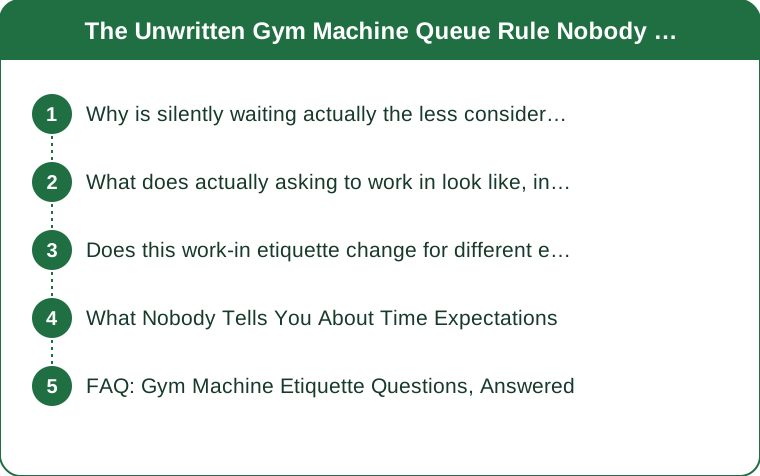
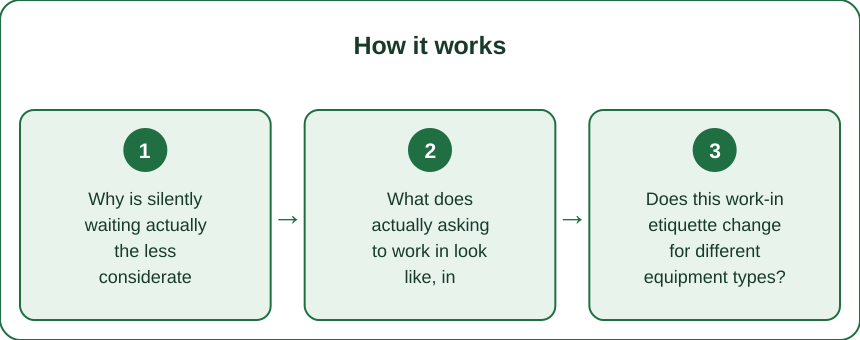
Why is silently waiting actually the less considerate option?
Because standing and waiting nearby without saying anything puts unspoken pressure on the person using the equipment and leaves you both worse off — they may feel rushed, and you lose time that a simple “working in” arrangement would have recovered. Asking directly is both more time-efficient and, counterintuitively, less socially awkward than the silent wait most beginners default to.
What does actually asking to work in look like, in practice?
A brief, direct “Mind if I work in between your sets?” is standard and almost universally well-received, since most experienced gym-goers have done the same thing themselves. It’s a normalized request, not an imposition, and most people respond by simply agreeing and swapping the equipment between each other’s sets.

Does this work-in etiquette change for different equipment types?
Somewhat — machines with adjustable settings (seat height, weight pin) are the most natural for working in, since resetting between users is quick, while free-weight setups with a specific, heavier loaded barbell can be more complicated to work in on, and a brief conversation about weight adjustment expectations upfront helps avoid confusion.
What Nobody Tells You About Time Expectations
There’s an unspoken norm around rest time between sets when working in — roughly matching or slightly extending your own rest to accommodate the other person’s sets rather than rushing back to the equipment the moment your own rest period ends, which keeps the arrangement feeling fair to both people rather than one person controlling the pace.
FAQ: Gym Machine Etiquette Questions, Answered
Is it rude to ask to work in on someone’s very last set or two?
Generally not — most people are happy to let someone hop on for a quick set or two near the end, and it’s a normal, low-stakes request either way.
What if the person using the machine says no or seems reluctant?
That’s their prerogative, and moving to a different machine or exercise variation without taking it personally is the appropriate response.
Does gym busyness level change these norms at all?
During peak hours, working in becomes even more expected and normalized, since equipment turnover matters more when demand is high — it’s less commonly done during quiet off-peak hours simply because there’s less need.
TL;DR:
- Asking to “work in” on a busy machine is the normal, expected etiquette, not an awkward imposition
- Silently waiting nearby is actually less considerate than directly asking to alternate sets
- Adjustable machines work in more easily than heavily loaded free-weight setups
- Matching rest time between users, rather than rushing, keeps the arrangement feeling fair
Asking directly is the norm experienced gym-goers already follow — it saves time for everyone involved, not just the person asking.
See It in Motion
Seen here: High Waist Jogger Sweatpants with Pockets — shop it on bubblelime.com
Keep Reading
This article is for general informational and styling purposes only. Fit, sizing, and product availability may vary.