How to Make the Most of a Time-Limited Gym Childcare Window
Quick Answer: With a fixed 60-90 minute childcare window, front-loading the highest-priority strength work first, keeping warmups short but not skipped, and using supersets or circuits instead of long rest periods gets a genuinely effective session done without cutting it close on pickup time.
The clock is running the second you drop off, and there’s nothing worse than getting into a good set and realizing you have eight minutes left. A time-boxed workout needs its own plan, not just a shorter version of your usual one.

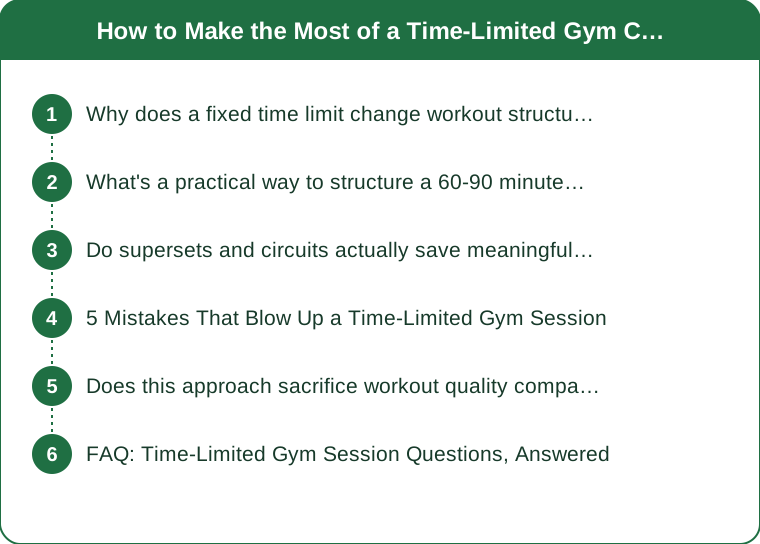
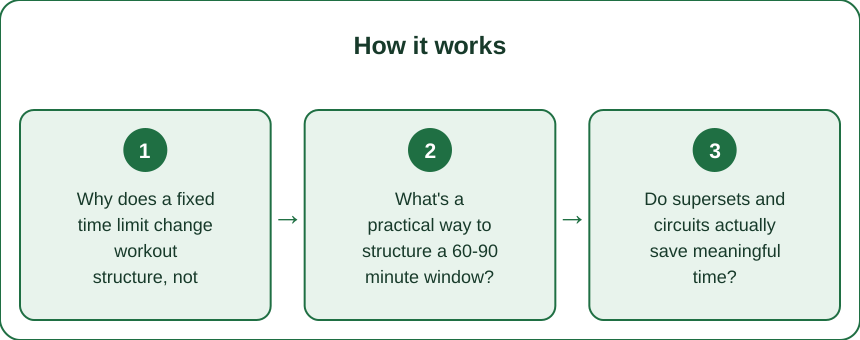
Why does a fixed time limit change workout structure, not just length?
An open-ended workout allows flexibility — resting longer if needed, adding an extra exercise if time allows, adjusting on the fly. A hard childcare deadline removes that flexibility entirely, meaning the workout needs to be planned with buffer built in from the start, not just shortened reactively when time starts running short.
The biggest practical shift is treating the highest-priority exercises as non-negotiable and first, so if time does run tight, what gets cut is the least important part of the session rather than the main lift you came in to do.
What’s a practical way to structure a 60-90 minute window?
5-8 minutes for warmup, 40-60 minutes for the main strength or workout block, and a 5-10 minute buffer before the actual pickup deadline accounts for realistic transitions (changing, checking out, walking to daycare) that eat into the window without feeling like “workout time.” Planning the session as if the real limit is 10-15 minutes shorter than the actual childcare slot prevents the common mistake of cutting it exactly to the minute.
Do supersets and circuits actually save meaningful time?
Yes, substantially — pairing exercises that use different muscle groups back-to-back (like a push exercise with a pull exercise) lets you use the “rest” period of one movement as active time for the other, cutting total session time significantly compared to traditional straight sets with full rest between each. This isn’t just a time-crunch trick — many strength programs use this structure intentionally regardless of time constraints.

5 Mistakes That Blow Up a Time-Limited Gym Session
Starting with a long, unstructured warmup. A focused 5-8 minute warmup is enough; longer eats into main workout time.
Chasing one more set on a lift when time is already tight. This is the single most common way sessions run over.
Not having a backup shorter version of the plan ready. If the gym is busier than expected, adapting on the fly beats abandoning structure entirely.
Underestimating transition and changing time. Five minutes disappears fast between finishing lifting and actually walking out the door.
Treating every exercise as equally important. Without a clear priority order, it’s easy to spend too much time on secondary work and rush the exercise that mattered most.
Does this approach sacrifice workout quality compared to a longer session?
Not necessarily — research on training density (work done per unit time) suggests a well-structured, time-efficient session can produce comparable strength and conditioning results to a longer, less structured one, particularly for general fitness goals rather than elite competitive training. The constraint often produces more focused, less wasted-motion training than an open-ended session where rest periods and exercise selection tend to drift.
FAQ: Time-Limited Gym Session Questions, Answered
How many exercises can realistically fit in a 45-minute main workout block?
For a strength-focused session, 3-5 compound-focused exercises structured as supersets is realistic without feeling rushed; more than that usually means sacrificing set quality for exercise variety.
Should cardio be included in a time-limited strength session, or done separately?
Brief, high-intensity cardio intervals worked into the circuit structure are more time-efficient than adding separate steady-state cardio; longer dedicated cardio sessions are better done on a different day if time allows.
What’s the best way to handle a day when the gym is busier than expected?
Having a pre-planned backup exercise for anything likely to have equipment competition (a substitute movement using different equipment) prevents losing session time to waiting for machines.
TL;DR:
- A fixed childcare window needs upfront structure, not just a shorter version of a normal workout
- Front-load the most important exercises so time cuts hit low-priority work first, not the main lift
- Supersets and circuits meaningfully reduce total session time versus straight sets with full rest
- Build in a 5-10 minute buffer beyond the actual deadline for realistic transition time
A time-boxed session isn’t a lesser workout — planned well, the constraint often produces more focused training than an open-ended hour where rest periods quietly drift longer than intended.
See It in Motion
Seen here: High Waist 8” Yoga Shorts — shop similar styles on bubblelime.com
Keep Reading
This article is for general informational and styling purposes only. Fit, sizing, and product availability may vary.