Training 3 Days a Week? Full-Body Beats the Split, and Here Is the Math
Quick Answer: At three days a week, a full-body approach wins for most people: every muscle gets trained three times weekly instead of once, a missed session costs you a third of everything rather than all of one thing, and the research on training frequency finds hitting muscles at least twice a week beats once at similar volume. Splits earn their place at four to five reliable days, or when preference keeps you consistent. The three-day full-body template is simple: squat, hinge, push, pull, core — rotated variations, progressed weekly.
The split is not wrong. It is scheduled for a life with more gym days than yours currently has.

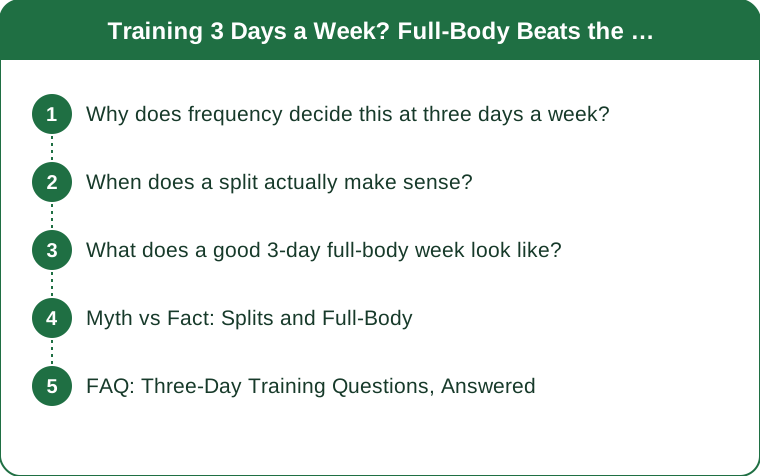
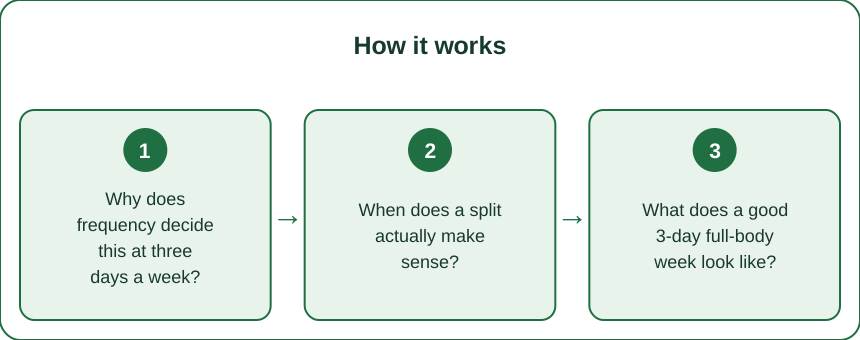
Why does frequency decide this at three days a week?
Because muscles grow from repeated signals, and a split on three days sends each muscle one signal a week.
Run the math on a classic split at three days. Legs Monday, back Tuesday… wait — at three days it becomes something like legs, upper push, upper pull. Each muscle group gets trained once per week — 52 growth signals a year. The full-body version trains every major group all three days at lower per-session volume: 156 signals a year at similar weekly volume.
The research on frequency backs the higher number. Reviews comparing training frequencies keep landing in the same place: muscles trained at least twice weekly grow better than once weekly at matched volume. The muscle-protein-synthesis window a session opens lasts roughly 24 to 72 hours — train a muscle Monday only, and Thursday through Sunday it is simply idling.
Missed sessions change the math even harder. Life cancels a workout most weeks somewhere. Miss leg day on a split and legs go untouched for two weeks — a real detraining gap. Miss a full-body day and every muscle still got two sessions that week. The full-body plan is failure-tolerant, and three-day schedules need failure tolerance more than they need anything else.
Recovery works with you, not against you. Full-body at moderate per-session volume means no single day devastates one area — you can walk stairs after every workout — while the split concentrates all of a muscle’s weekly work into one session it may not even benefit from fully, since late sets in a fried muscle produce diminishing returns.
The one honest cost: full-body sessions feel less like sculpting and more like practicing. That is a feature wearing a disguise.
When does a split actually make sense?
At higher frequency, higher volume, or higher attachment. Splits are a tool, not a rank.
Four to five reliable days is split territory. Once you train often enough that an upper-lower or push-pull-legs rotation still hits everything twice weekly, the frequency argument dissolves — upper-lower across four days is arguably the sweet spot of the entire debate, and at five to six days, splits become nearly mandatory just to manage recovery.
Advanced volume needs the room. After a couple of years of progression, the volume a muscle needs can stop fitting into thirds of a session. Splitting is how experienced lifters buy each muscle more focused work — this is why competitors split, and why their template says nothing about a three-day beginner year.
Specific priorities justify hybrid designs. Chasing glute growth or pressing strength specifically? A full-body base with one emphasis day — or an upper-lower with an extra lower day — targets without abandoning frequency.
And preference is a real variable. The program you enjoy is the program that happens. If leg day is the ritual that gets you through the door and you genuinely hold four days most weeks, a split executed beats a full-body skipped — adherence outranks optimization, always.
What does not justify a split at three days: the idea that splits are what serious people do. Gym culture inherited the bro split from bodybuilders training six days on pharmaceutical-grade recovery; copying the format without the frequency imports the cost and skips the benefit. Serious, at three days, looks like squatting three times a week and adding five pounds a month.

What does a good 3-day full-body week look like?
Five movement patterns, rotated flavors, one progression rule. Forty-five minutes a session.
Every session is built from the same skeleton: a squat pattern, a hinge, a push, a pull, and a core or carry finisher. The flavors rotate so nothing is repeated back-to-back and joints see variety:
Day A: goblet squat, Romanian deadlift, dumbbell bench press, seated cable row, plank series.
Day B: dumbbell split squat, glute bridge or hip thrust, overhead press, lat pulldown, farmer carry.
Day C: leg press or back squat, back extension, incline press, one-arm dumbbell row, dead bug plus side plank.
Three working sets of 6 to 12 reps per movement, leaving one or two honest reps in the tank on most sets. That is 15 working sets per session, done inside 45 to 55 minutes with normal rest.
The one progression rule: beat your logbook slightly. Add a rep, then another, and when the top of the rep range arrives, add weight and drop back down. This double-progression loop is the entire engine — the notebook (or notes app) is as important as any piece of equipment you will touch.
Spacing: a day between sessions — Monday, Wednesday, Friday is the classic because it works. Back-to-back days occasionally are fine; the pattern matters more than perfection.
Practical details that quietly matter: warm up with two lighter ramp sets on the first lower and first upper movement; wear what lets you check positions — squat-proof leggings and a supportive sports bra exist for exactly the squat-hinge-press day this is; and if the gym floor intimidates on busy nights, the whole template runs from one bench and two pairs of dumbbells in a corner.
This is general fitness guidance. New lifters with joint issues or health conditions benefit from a session or two with a qualified coach to set movement standards.
Myth vs Fact: Splits and Full-Body
Myth: Splits are for serious lifters, full-body is for beginners. Fact: Frequency math, not seriousness, decides it. Plenty of advanced lifters run full-body or upper-lower for years; the six-day bro split is a specialist tool imported from bodybuilding schedules most lives cannot host.
Myth: Training a muscle three times a week is overtraining. Fact: At moderate per-session volume, thrice-weekly training sits comfortably inside recovery for healthy adults — total weekly volume is what needs managing, not the calendar spread. Soreness that never clears means volume is high, not frequency.
Myth: You cannot build glutes without a leg day. Fact: Three full-body days can contain more weekly glute sets than one leg day — a squat pattern and a hinge every session adds up fast. Concentration is one way to volume; distribution is another, with better recovery.
Myth: Full-body workouts take forever. Fact: Five movements at three sets is a 45-to-55-minute session. The split day chasing six exercises for one muscle usually runs longer — and does it for a muscle that will then rest for a week.
Myth: You must destroy a muscle for it to grow. Fact: Growth follows tension and progression, not annihilation. Moderate repeated doses out-build weekly demolition for most natural lifters — which is precisely the full-body advantage at low frequency.
FAQ: Three-Day Training Questions, Answered
Will I recover training the same muscles three times a week?
Yes, at moderate per-session volume — five hard sets per muscle per day recovers far more easily than fifteen sets crammed into one session. If soreness lingers into the next workout consistently, trim a set per movement rather than a day.
Can I still emphasize glutes or arms on a full-body plan?
Easily: add one targeted movement to each session’s finisher slot — hip thrusts, curls, whatever the priority is. Three small emphasis doses a week outperform one big one for most goals anyway.
What if I sometimes get a fourth day?
Keep the three full-body sessions and make the bonus day easy specialization or conditioning — a brisk incline walk, extra core and glute work, mobility. If four days becomes reliably permanent, upper-lower is the natural graduation.
How long until a full-body plan shows results?
Strength moves within three to four weeks — the logbook shows it first. Visible change follows over two to three months with consistent progression and adequate protein. The plan works exactly as fast as the notebook fills.
TL;DR:
- At three days a week, full-body trains every muscle three times weekly versus a split’s once — and the frequency research favors at least twice.
- Full-body is failure-tolerant: a missed day costs a third of everything, not a whole muscle group’s entire week.
- Splits earn their place at four to five reliable days, advanced volume needs, or when preference drives adherence.
- The template: squat, hinge, push, pull, core — three sets each, rotated variations, and a logbook you beat slightly every week.
Write Day A in your notes app and do it this week. The program fits on an index card, which is exactly why it works.
See It in Motion
Seen here: Super High Waist Embossed Yoga Leggings with Inner Pocket — shop it on bubblelime.com
Keep Reading
This article is for general informational and styling purposes only. Fit, sizing, and product availability may vary.